Alcohol Delivery Compliance: ID Checks, Laws, and POS Controls
Alcohol is the only line on your menu where one bad handoff can cost you the license that makes the rest of the menu possible. The way to survive it is to stop relying on anyone remembering.
Every other compliance failure in a restaurant is survivable. A health inspection finding gets corrected. A wage claim gets settled. An alcohol violation on a delivery reaches something more fundamental, because the penalty ladder in most states runs from a fine to a suspension to revocation, and a suspended license does not only stop the drinks. It reshapes the check average, the dinner business, and the valuation of the whole operation.
What makes that asymmetry dangerous is where the failure actually occurs. Operators picture the risk at the door, with a nervous driver squinting at a license. In practice, the door is the last and least likely point of failure. The violation was usually created much earlier — when the order was accepted 20 minutes after the legal cutoff, when it was routed to a 19-year-old driver because he happened to be next up, or when it went to an address across a boundary the ordering page had never heard of.
Those are all system defects, and system defects respond to system fixes. Below are the four layers that convert alcohol delivery from a nightly gamble into an ordinary, auditable part of the operation.
Layer One: Are You Actually Permitted to Do This?
The threshold question is narrower than most operators assume, and "our state allows it" is rarely the end of the analysis. Work through all six:
- License class and delivery endorsement. An on-premise license usually does not by itself authorize delivery. Many states require a separate delivery permit, endorsement, or off-premise privilege attached to the existing license.
- Product scope. Some jurisdictions permit beer and wine only. Others allow spirits, or allow cocktails only in tamper-evident sealed containers with specific labeling. Draft beer in growlers is treated differently again.
- Container and packaging rules. Original sealed manufacturer packaging is the common standard, with mixed drinks requiring a tamper-evident seal and often a label listing contents, volume, and the licensee.
- Food requirement. Several states allow alcohol delivery only as part of a food order, sometimes with a minimum food dollar amount or a ratio.
- Hours and days. Delivery hours are frequently narrower than on-premise service hours, and Sunday restrictions still apply in many places.
- Geography. Local option means a dry city or a partially dry county can sit inside a wet state. Your delivery radius almost certainly does not align with those boundaries by accident.
Get the answers in writing from your state board and keep them with your license file. If any of this is unfamiliar territory, the groundwork in this restaurant liquor license guide covers the license classes and application mechanics that sit underneath the delivery question.
Layer Two: Who Is Allowed to Carry It
This is the layer that most often produces a violation on an otherwise clean delivery, because the requirement lives in your scheduling and dispatch, not at the door.
Most states require that the delivering person be at least 21, be an employee or contracted agent of the licensee, and hold current responsible-service training. Some require an individually issued permit for the person, not just the business. A few allow 18-to-20-year-olds to deliver alcohol under supervision conditions, which is exactly the kind of detail you should verify rather than assume in either direction.
The operational consequence is that alcohol orders can only be dispatched to a subset of your roster. That subset changes as certifications expire and people leave. If your dispatch does not know the difference, then on a busy Saturday it will eventually hand a beer order to whoever is standing closest, and the compliance program will have failed silently.
Handle it structurally: store each driver's date of birth, certification type, certificate number, and expiry alongside their record, block dispatch of any alcohol-flagged order to a driver who fails those checks, and alert 30 days before a certification lapses. Certification capture belongs on the driver onboarding checklist at hire, and the ongoing eligibility check is exactly the kind of thing driver management software should be doing rather than a manager with a spreadsheet.
The safest alcohol order is the one the system will not let you get wrong. KwickSpot runs on KwickOS, flagging alcohol at the item level and refusing to route those orders to drivers who are not eligible on age or certification.
Start your free trial — no credit card needed →Layer Three: The Handoff Itself
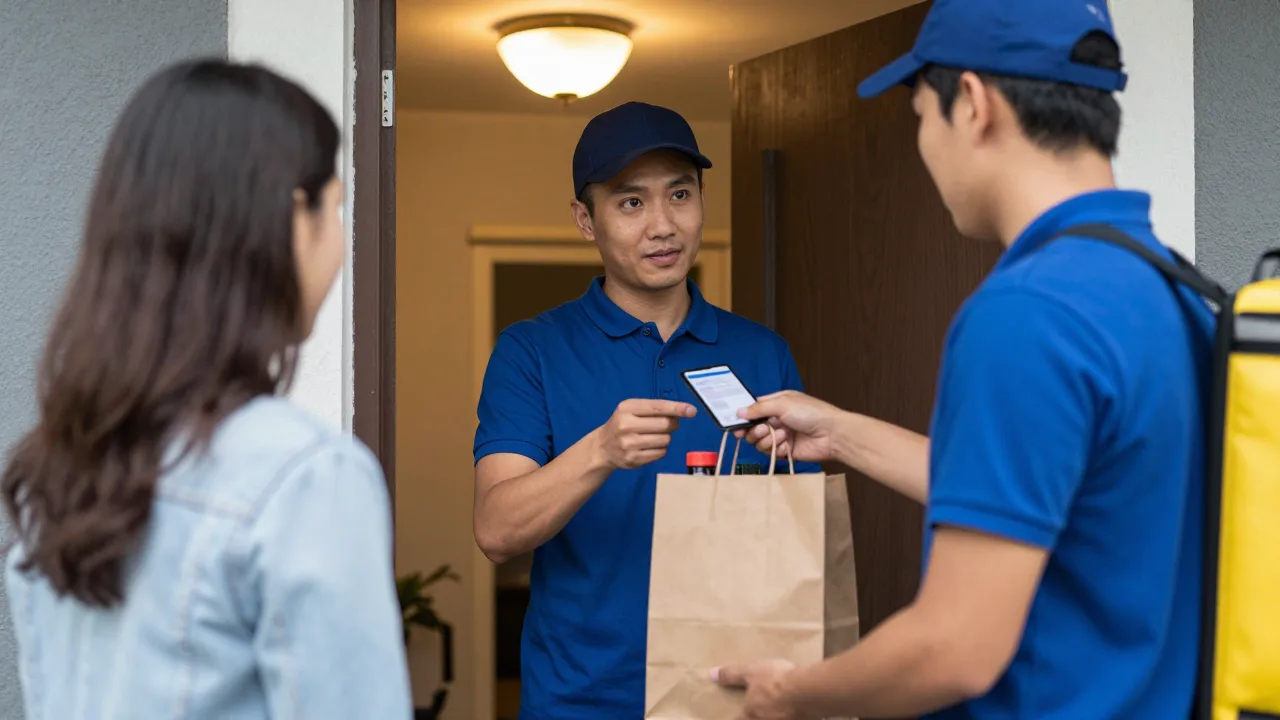
At the door, five rules govern, and every one of them should be a step in the driver app rather than a line in a handbook nobody reopened after training day.
- Check a valid, unexpired government photo ID. Physical or, where the state accepts it, a recognized digital ID. Confirm the photo matches the person in front of you and that the ID has not expired.
- Confirm 21 or older. Scan or enter the date of birth so the app does the arithmetic. Mental math at a dark door on a cold night is how borderline cases become violations.
- Assess for visible intoxication. Refuse if the recipient appears intoxicated. Dram shop exposure follows the alcohol, not the address, and a delivered drink to an already-impaired person is precisely the fact pattern plaintiffs' lawyers look for.
- Capture the acknowledgment. A signature or electronic acknowledgment where required, plus a timestamped record of the check. Same infrastructure as any proof of delivery system, applied to a much higher-stakes transaction.
- Never leave it. No porches, no lobbies, no neighbors, no "just leave it by the door." Contactless delivery and alcohol are mutually exclusive, and the customer's instruction to leave it does not transfer the liability.
Recipient identity deserves one more note. The person accepting delivery must themselves be of age, which means an adult signing for a minor's order is not a workaround, and neither is a 21-year-old accepting on behalf of the 19-year-old who placed it. If the person at the door cannot pass the check, the alcohol goes back.
Layer Four: The POS Controls That Do the Real Work
Here is the argument at the center of this whole article: training tells people what to do, but controls decide what can happen. A compliance program built on reminders degrades every month as people get busy. A program built on hard stops holds.
| Control | What it prevents | Where it is enforced |
|---|---|---|
| Item-level alcohol flag | Everything downstream; nothing works without it | Menu configuration |
| Legal-hours lockout | Orders accepted past the delivery cutoff | Online ordering and POS |
| Permitted-zone check | Delivery into a dry or unlicensed area | Checkout address validation |
| Quantity cap per order | Volume limits exceeded on a single ticket | Cart rules |
| Food-accompaniment rule | Alcohol-only orders where prohibited | Cart rules |
| Certified-driver routing | Dispatch to an underage or uncertified driver | Dispatch engine |
| Mandatory ID step before completion | Undocumented handoffs | Driver app |
| Retained audit trail | Inability to prove compliance later | Reporting |
Two of these deserve emphasis. The permitted-zone check is the one operators skip most often, usually because the delivery radius was drawn as a circle around the store and nobody compared it to a jurisdiction map. Draw the alcohol-permitted zone as its own layer, separate from your food delivery zone, and let checkout enforce the difference. The mandatory ID step is the one drivers push back on, right up until the first time an audit or a complaint gets resolved in ninety seconds because the record existed.
Example scenario: a neighborhood gastropub adding beer and wine delivery
Illustrative scenario — a composite example built to show how the numbers work. It does not describe a real business or customer.
Consider a neighborhood gastropub in Portland, OR that adds beer and wine delivery in 2024 and treats compliance as a training matter: a 30-minute session, a signed acknowledgment, an ID-check reminder on the ticket. It holds for about five months. Then a routine compliance check catches a delivery dispatched at 11:12 p.m., 12 minutes past the local cutoff, by a shift lead who has genuinely lost track of the time on a busy night. The fine is $1,500 and the file is flagged for follow-up, which means every subsequent visit starts from a worse position.
Reviewing its own data afterward, the operation finds more that had simply never surfaced: 23 alcohol orders in the prior quarter dispatched to drivers whose server certification had expired, and four deliveries into an address just past a boundary the radius crossed without anyone noticing.
Suppose the program is then rebuilt around controls instead of reminders. Alcohol items get flagged in the menu. The ordering page hard-stops alcohol 25 minutes before the legal cutoff, giving the kitchen a buffer. Certification and date of birth go into driver records with automatic dispatch blocking and a 30-day expiry warning. The driver app requires a scanned ID and a captured acknowledgment before an alcohol order can be closed. The alcohol delivery zone is drawn separately from the food zone.
Eighteen months and roughly 9,400 alcohol deliveries later, there are no violations and no after-hours dispatches, because the system will not accept one. The lesson of the example is that compliance is not about hiring careful people. It is about building something where the careless version of the night is not available.
Third-Party Marketplaces Do Not Transfer the Risk
When a marketplace app delivers your alcohol, you are still the licensee, and in most states the responsibility for the sale still runs back to you. Some platforms carry their own delivery permits and certify their couriers; some pass the obligation entirely to the restaurant. Before enabling alcohol on any third-party channel, get three things in writing: whether the platform holds the required permit in your jurisdiction, what age and certification standard their couriers meet, and what ID verification record they will produce for you on request. If any answer is vague, keep alcohol on your own drivers, where the controls are yours.
Refusals, Records, and the Rest of the Program
Refusal protocol. When a check fails, the driver refuses the alcohol portion, logs a reason code, still delivers the food, and returns the product to the store for restock. Decide the refund rule in advance and publish it at checkout so the driver never negotiates money at a doorstep. Reason codes also give you a monthly report on how often refusals happen and why.
Recordkeeping. Retain the per-delivery record — timestamp, driver, ID verification result, acknowledgment — for at least the period your state requires, commonly two to three years, and keep certification records for the same period. The point of the archive is that it exists on the day someone asks for it.
Training that reinforces the controls. Certification at hire, a short annual refresher, and periodic internal checks where a manager reviews a sample of alcohol deliveries for complete records. Document the training the same way you document your other employment obligations; the discipline is identical to what this restaurant labor law compliance overview describes for wage and hour records.
Insurance. Confirm that liquor liability extends to off-premise delivery and that your non-owned auto coverage contemplates alcohol transport. Both are common gaps, and both belong in the same conversation as the rest of your delivery insurance coverage.
Prove compliance in one export, not one panic. KwickSpot on the KwickOS platform stamps every alcohol delivery with driver eligibility, ID verification, and acknowledgment, then retains it in a report you can hand to a regulator.
Join 5,000+ restaurants — get started free →The Five Failures Worth Designing Out
- Relying on training instead of hard stops. Reminders decay. Locks do not.
- An alcohol zone identical to the food zone. Jurisdiction boundaries do not follow your delivery radius.
- Certification tracked on paper. An expired certificate that dispatch cannot see is a violation waiting for a busy night.
- Leaving alcohol at the door. The customer's request does not move the liability, and it is a per-incident violation.
- Assuming a marketplace owns the compliance. The license is yours, and so, in most states, is the consequence.
Frequently Asked Questions
Can restaurants legally deliver alcohol?
In most states, yes, but only with the right license class and usually an additional delivery permit or endorsement on top of the on-premise license. Authority is state by state and often county or city by city, with local-option dry areas that override state rules. Some states also limit which products qualify, restrict hours, or require that alcohol accompany a food order, so confirm your own jurisdiction with the state alcohol board before selling a single delivered drink.
Who is allowed to deliver alcohol from a restaurant?
Most states require the delivering person to be at least 21, employed or contracted by the licensee, and trained in responsible alcohol service, and several require an individually issued server or delivery permit. That combination means alcohol orders can only be dispatched to a subset of your roster. Assigning one to an uncertified or underage driver is a violation even when the delivery itself goes perfectly.
What ID rules apply to alcohol delivery?
The driver must check a valid, unexpired government-issued photo ID at the door, confirm the recipient is 21 or older, and confirm the recipient is not visibly intoxicated. Many states additionally require a signature or an electronic acknowledgment and require the record to be retained. Alcohol may never be left unattended at a door, in a lobby, or with a neighbor, regardless of what the customer requested.
What POS controls reduce alcohol delivery risk?
Flag alcohol at the item level, then enforce hard stops rather than reminders: block alcohol orders outside legal delivery hours, block delivery addresses outside your permitted area, allow dispatch only to certified drivers who are 21 or older, require a completed ID verification step before an order can be marked delivered, and cap quantity per order. Controls that make a violation structurally impossible outperform training that asks people to remember.
What should a driver do if the customer cannot show valid ID?
Refuse the alcohol portion, log the refusal reason in the app, and return the product to the store for restock. The food portion can still be delivered. Never accept an ID for someone who is not present, never hand alcohol to a third party at the door, and never leave it behind because the customer promises to show ID later. Refunds for a lawful refusal should follow a written policy so the driver never has to negotiate at the door.
Become a KwickOS Reseller
POS dealers and restaurant technology consultants: add KwickOS and KwickSpot to your portfolio. Give your clients alcohol hard stops, certified-driver routing, and audit-ready delivery records built into their POS, and earn recurring revenue on every account.
Learn About the Reseller ProgramKwickOS Ecosystem
© 2024-2026 KwickOS. All rights reserved.