Winter and Severe Weather Delivery Operations
Same storm, same city, two stores five miles apart. One posted its best delivery night of the quarter. The other did $1,900, two hours of 90-minute waits, and a bumper in a ditch.
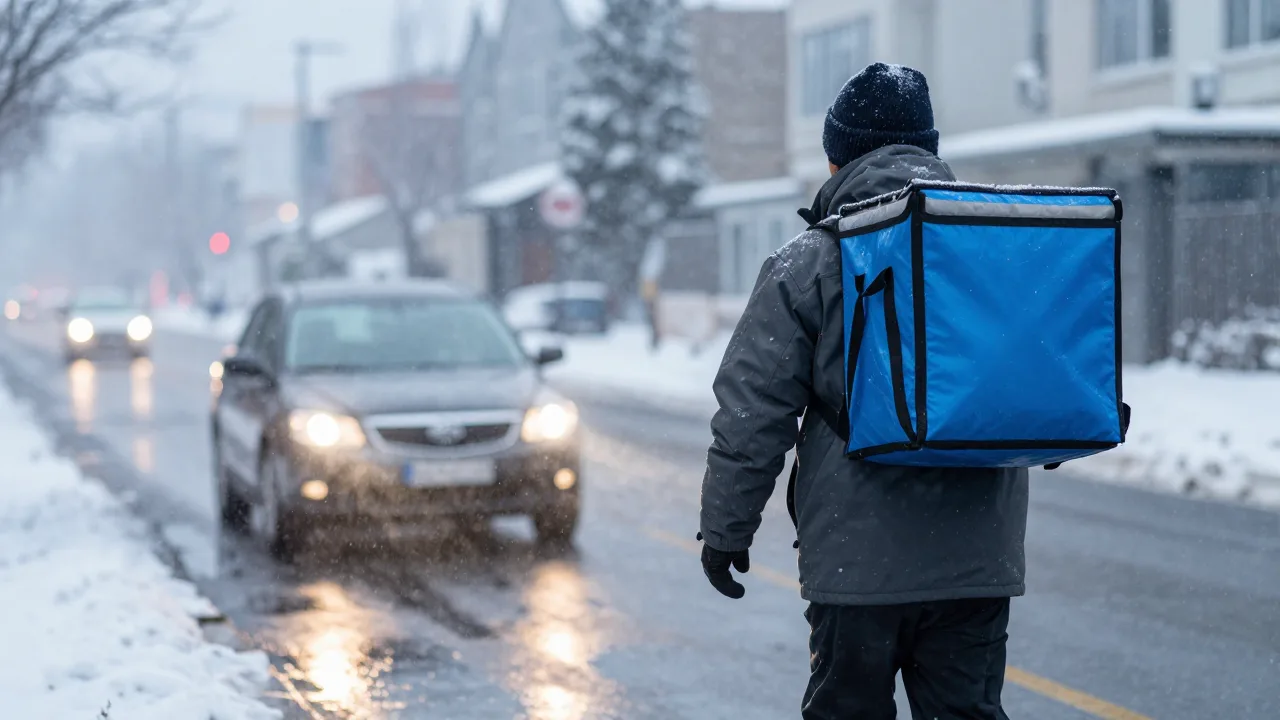
The difference between those two stores was not the weather, the drivers, or the neighborhood. It was that one of them had decided in advance what a four-inch snowfall meant — what the radius shrinks to, what the quoted window becomes, how many orders can be in the air at once, and what conditions stop delivery entirely. The other store found out in real time, at 6:40 p.m., with a full queue and a manager improvising.
Weather is the only demand shock that arrives with a forecast. You get 12 to 48 hours of warning, which is more notice than you get for anything else that can wreck a shift. Almost nobody uses it, because the plan lives in a manager's head and gets rebuilt from scratch every storm.
The Two Curves That Cross
Start with why weather nights break stores that handle a normal Friday fine. Two things move at once, in opposite directions.
Demand rises. Delivery volume typically climbs 20 to 40% in rain and light snow. Delivery's share of total sales climbs further, because dine-in traffic drops at the same time and the mix tilts hard toward the channel that just got harder to run.
Capacity falls. Drive times lengthen 35 to 60% on snow-covered or heavily wet roads. Some drivers call out or decline the shift. Parking gets worse, walk-ups get slower, and every handoff takes longer because people are bundled up and doors stick.
| Condition | Order volume | Drive time | Effective delivery capacity |
|---|---|---|---|
| Clear evening (baseline) | 100% | 100% | 100% |
| Steady rain | +18–25% | +15–25% | ~82% |
| Light snow, roads treated | +25–40% | +35–50% | ~68% |
| Heavy snow, untreated | +30–45% | +60–90% | ~50% |
| Freezing rain / ice | +40% | Unpredictable | Suspend |
Read the light-snow row carefully, because it is the one that gets stores in trouble. Demand up 30%, capacity down to about two-thirds — a mismatch of nearly two to one. No amount of hustle closes that gap. Something has to give, and if you have not chosen what, the thing that gives is your promise times, then your food quality, then your driver's control of the vehicle.
Build the Tiers Before the Forecast
A weather playbook is four tiers with hard triggers, published to every manager, and applied by whoever is on duty without a phone call. Here is a structure that works for most single-store and small-group operations:
| Tier | Trigger | Radius | Promise window | Driver pay |
|---|---|---|---|---|
| Green | Normal conditions | Full | Standard | Standard |
| Yellow | Steady rain, wind advisory, wet roads | 85% | +10 min | +$2 / delivery |
| Orange | Winter weather advisory, snow accumulating, temp near freezing | 50–60% | +25 min | +$4 / delivery |
| Red | Ice storm or blizzard warning, official advisory against travel, unplowed primary roads | Delivery suspended | Pickup only | Shift pay honored |
Three details make or break this table. First, the triggers must be observable, not judgment calls. "A winter weather advisory is in effect for the county" is a trigger. "It looks bad out" is a conversation. Second, freezing rain is always Red, no matter how light. Glaze ice takes vehicle control away from skill entirely, and it is the condition behind a disproportionate share of delivery crashes. Third, the tier is announced, not discovered: when the shift lead moves to Orange, the ordering page, the drivers, and the kitchen all learn it at the same moment.
One switch should move the whole operation. KwickSpot runs on KwickOS, so changing weather tier can shrink the delivery map, extend quoted windows, and cap concurrent orders across every channel at once instead of five manual edits.
Start your free trial — no credit card needed →The Five Levers, Ranked by Impact
Once a tier is active, you have five things you can actually pull. They are not equally useful, and operators tend to reach for them in exactly the wrong order.
1. Shrink the Radius (Biggest Lever)
Cutting the map attacks drive time at the source, and drive time is the variable the storm is inflating. A zone that takes 11 minutes on a clear night takes 18 in snow; the far zone that takes 19 becomes 32, and that single order eats a third of a driver's hour. Pre-draw your storm zones so nobody is redlining a map at 5 p.m. Operators who have already done the work of delivery zone optimization get this nearly free, because the boundaries and their drive times are already documented. Distance-based pricing helps too, and the mechanics carry over directly from ordinary delivery zone pricing strategy.
2. Widen the Promise Window
Add 10, 25, or more minutes by tier and say so at checkout. A guest told "70–90 minutes tonight because of the snow" and served in 78 is satisfied. The same guest quoted 45 and served in 78 leaves a one-star review about a restaurant that could not handle weather. The delivered experience is identical; only the expectation differed.
3. Cap Concurrent Orders
Set a hard ceiling on how many delivery orders can be open at once, calculated from drivers on the road times a realistic per-hour rate for the conditions. When the cap is hit, delivery goes temporarily unavailable and pickup stays open. Turning orders away feels wrong on a busy night, which is precisely why the cap has to be a number set in advance rather than a decision made at 7:15.
4. Trim the Menu
Pull items that do not survive a 30-minute cold ride or that tie up the line: elaborate plating, fried items that go soggy, anything ice cream. A shortened storm menu speeds the kitchen and raises the odds the food is still good on arrival. Say it plainly on the ordering page rather than 86ing items silently.
5. Batch More Aggressively
Loosen your batching window so more orders ride together. On a normal night, tight batching hurts freshness. In a storm, the alternative is a driver making a second dangerous trip, so two or three orders per run is the safer trade as long as the batch stays geographically tight.
The Driver Side, Which Is the Part That Matters Most
Everything above is logistics. This part is liability, and it is where a bad weather night becomes a permanently bad outcome.
- Volunteers, never assignments. Any driver may decline a weather shift with no penalty, no schedule retaliation, and no argument. Write it down and mean it.
- Storm pay that makes volunteering attractive. A $3 to $6 per-delivery premium or an hourly differential gets you the experienced drivers who want the shift, instead of the newest hire who felt obligated.
- Vehicle check at clock-in. Tire tread, working wipers and defroster, headlights, at least half a tank, a scraper in the car. A two-minute check has stopped more storm incidents than any amount of coaching.
- Explicit permission to refuse a run. An unplowed hill, a flooded underpass, a road that looks wrong — the driver turns around and dispatch backs them, every time. The stated policy is that no order is worth a crash, and it has to be stated out loud before the storm, not after.
- Check-ins. On Orange nights, dispatch confirms position at each delivery. A driver who goes quiet for 20 minutes gets a phone call.
Fold the weather module into your standing driver safety training rather than delivering it as a pre-shift speech during the first snowfall. Drivers absorb this material in October far better than they do at 5 p.m. on the night it matters. And remember that a crash on a delivery run reaches your business through non-owned auto liability and workers' compensation regardless of whose car it was.
Example scenario: a two-unit Polish kitchen in a snow-belt city
Illustrative scenario — a composite example built to show how the numbers work. It does not describe a real business or customer.
Consider a two-unit Polish kitchen in Buffalo, NY, a city that delivers roughly a dozen serious snow events a year. For three seasons the owner handles them the same way: keep delivering, apologize a lot. The worst night, in January 2025, produces 31 late orders, $1,150 in refunds and comps, a driver who slides into a curb and bends a control arm, and a two-hour stretch where the kitchen stops cooking because there is nowhere to put finished food.
Suppose that the following autumn the owner builds a four-tier playbook and tapes it inside the office door. Triggers come from National Weather Service advisories so nobody has to interpret. Orange cuts the radius from 5.5 miles to 3, adds 25 minutes to every quote, caps open delivery orders at 9, and pays $4 extra per run. Red means pickup only, announced by 3 p.m. whenever possible.
Across the next winter's eleven weather events, refunds and comps total about $1,400 for the entire season, down from roughly $4,600 the year before. Delivery revenue on Orange nights actually rises about 12%, because a shorter radius with honest 80-minute quotes turns more of the demand into completed orders instead of cancellations. There are no vehicle incidents. Turning off the far zone feels like leaving money on the table. In this example, the far zone is where the money was going to die anyway.
Heat Is Weather Too
Winter dominates the conversation, but extreme heat carries its own operational and safety load, and it is arriving in more markets each year. Above roughly 95°F, cold items degrade fast in a hot car, so insulated cold bags stop being optional and hold times need to shorten. Drivers face genuine heat illness risk in vehicles without working air conditioning — make AC a vehicle-check item, stock water at the store, and build in cooling breaks. Severe thunderstorms deserve their own trigger as well: lightning and flash flooding warrant an Orange or Red posture just as readily as snow, and flooded roadways are more lethal than they look.
Tell People Before They Find Out
Communication is the cheapest lever on the list and the most often skipped. Three messages cover it:
- Before the storm. A banner on the ordering page and a social post by early afternoon: conditions expected, delivery may be limited, pickup available.
- At tier change. Update quoted windows automatically and show the reason. "Delivery times extended tonight due to snow" reads as competence, not weakness.
- At suspension. Announce it plainly with a reassessment time, keep pickup open, and be specific about why. Guests accept a 4 p.m. suspension notice far more easily than a 7 p.m. cancellation.
The same discipline that governs any operational disruption applies here, and the framework in this guide to small business crisis management maps cleanly onto a snow night: decide the triggers in advance, say it early, and keep the message consistent across every channel.
Learn From Each Event
The morning after, spend fifteen minutes on a written review while the details are fresh: which tier was called and when, actual versus quoted delivery times, refunds and comps, any near-misses, and which zones caused the most trouble. Three or four of these reviews will tell you more about your operation's real limits than a season of guessing.
Feed the results back into two places. Your staffing model should learn that Orange nights need fewer drivers on more experienced legs plus one extra expo hand, which is the same capacity thinking behind good peak hour delivery management. And your forecasting should learn that weather is a predictable input, not a surprise — incorporating it into delivery demand forecasting is what lets you prep the right amount of food and schedule the right crew a day ahead instead of reacting at four o'clock.
Make the storm plan a setting, not a scramble. KwickSpot on the KwickOS platform stores your weather tiers with their radius, promise-time, and order-cap rules so a shift lead can activate the whole playbook in one tap.
Join 5,000+ restaurants — get started free →Mistakes That Turn a Snow Night Into a Bad Week
- Keeping the full radius. The far zone consumes drivers at triple the normal rate and produces the latest, coldest orders on the board.
- Quoting normal times. Every one of those tickets becomes a complaint you could have prevented with a sentence.
- Pressuring a reluctant driver. The cost of one crash dwarfs the revenue of an entire storm night.
- Waiting to suspend until orders are already in the queue. Cancelling accepted orders is far worse for trust than pausing before they are placed.
- Never debriefing. Without a written review, you relearn the same lesson every winter at full price.
Frequently Asked Questions
Should restaurants keep delivering during a snowstorm?
Deliver through advisories with a reduced radius and longer promise windows, and suspend entirely for freezing rain, blizzard warnings, or any official advisory against non-essential travel. The decision should be made by a written trigger, not by a manager weighing a busy night against a driver's safety in the moment. Freezing rain in particular deserves an automatic stop, because vehicle control is unrecoverable on glaze ice regardless of driver skill.
How much does bad weather increase delivery demand?
Delivery order volume commonly rises 20 to 40 percent during rain and light snow, and the delivery share of total sales rises further because dine-in traffic falls at the same time. The trap is that drive times lengthen 35 to 60 percent on the same night and some drivers call out, so effective capacity drops by roughly a third precisely when orders peak.
Should you pay drivers more during severe weather?
Yes. A storm premium of $3 to $6 per delivery or an added hourly differential is standard practice and it is cheaper than the alternative. Weather shifts require fewer, more experienced drivers, and paying a premium is what makes those drivers volunteer rather than making a manager pressure someone reluctant, which is where most weather-related incidents begin.
How should I change my delivery radius in bad weather?
Cut it to the zone your drivers can complete in the same drive time as a normal night, typically 40 to 60 percent of your fair-weather radius, and drop any zone that requires a highway, a steep grade, or an unplowed rural road. Shrinking the map does more for on-time performance and safety than any other single storm lever because it attacks drive time at the source.
What should a restaurant tell customers when delivery is suspended?
Say it early, say it plainly, and give an alternative. Post a banner on the ordering page before the storm arrives rather than after, state that delivery is paused for driver safety with an expected reassessment time, and keep pickup open with a clear note about conditions. Guests accept a suspension announced at 4 p.m. far better than an order cancelled at 7.
Become a KwickOS Reseller
POS dealers and restaurant technology consultants: add KwickOS and KwickSpot to your portfolio. Give your clients one-tap weather modes for radius, promise times, and order caps, and earn recurring revenue on every account.
Learn About the Reseller ProgramKwickOS Ecosystem
© 2024-2026 KwickOS. All rights reserved.