Handling Failed Deliveries and Address Errors
Nobody answers the door. The number in the ticket rings out. Your driver has now been standing on a stranger's porch for eleven minutes with $54 of cooling food and three orders waiting in the car.
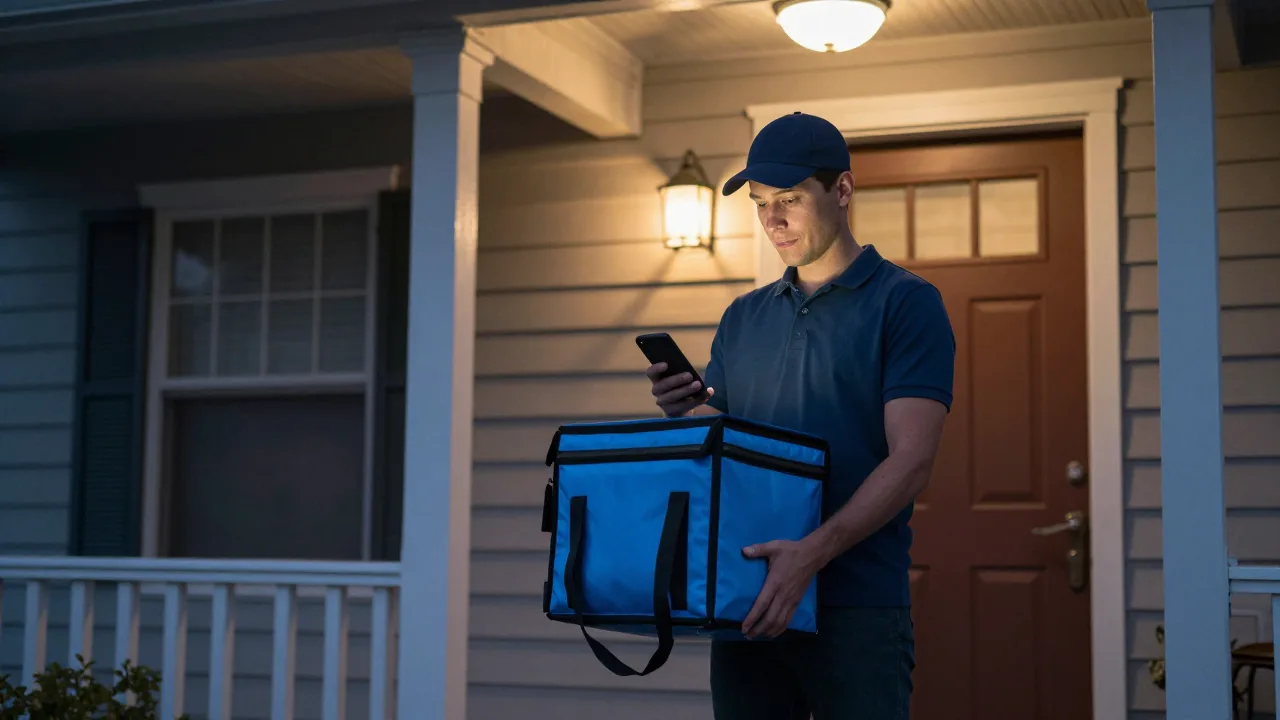
Most operators file that porch scene under bad luck. It is not bad luck. It is an order that entered your system with a defect, traveled all the way to a doorstep before anyone noticed, and is now being resolved by the person with the least information and the least authority in the entire company — a driver in the dark, guessing.
Look at what the failure actually costs. The food is gone: call it $16 in food cost on a $54 ticket. The driver's time on scene plus the return trip runs 25 minutes of paid labor. The three orders behind it in the car each land 12 to 18 minutes late, which is how one failure turns into four unhappy guests. Refund the ticket and you are out the revenue too. All in, a single failed delivery on a busy Friday commonly costs $70 to $95 once you count the downstream damage, and it is the downstream damage nobody ever attributes to the original event.
Worse, failures cluster. The apartment complex with the unlabeled buildings does not fail once. The gated community whose call box has been broken since spring fails every time until someone writes it down. Without a system, each incident is rediscovered from scratch by whichever driver drew the short straw, and the institutional knowledge lives in the heads of the two people who have been there longest.
So build the system. It has three layers: a checkout gate that catches bad addresses before they become orders, a timed at-the-door protocol that removes judgment from the moment, and a written resolution policy that lets a shift lead close the loop without calling you.
The Five Ways a Delivery Fails
Before you can fix failures, sort them. Lumping every incident into "customer wasn't there" hides the fact that the causes have completely different fixes.
| Failure type | Share of incidents | Where it is really fixed |
|---|---|---|
| Incomplete address (missing unit, wrong building) | ~35% | Checkout validation |
| Customer unreachable at the door | ~25% | Arrival notifications |
| Access blocked (gate, lobby, campus, badge) | ~20% | Address notes and gate codes |
| Wrong address entered entirely | ~12% | Geocode confidence checks |
| Order refused or disputed at the door | ~8% | Order accuracy and payment policy |
The proportions shift with your trade area — a downtown store skews toward lobby access, a suburban store toward missing unit numbers — but the pattern holds almost everywhere: the majority of failures are data problems, not driver problems. That is good news, because data problems can be engineered out and driver problems cannot.
Layer One: Stop Bad Addresses at Checkout
Every failure you prevent here costs nothing to prevent and $70 to fix later. Six controls do most of the work:
- Geocode as they type. Autocomplete against a real address database rather than accepting free text. Free-text address fields are the single largest source of undeliverable orders in restaurant delivery.
- Require the unit number. If the geocoder identifies a multi-unit building, make apartment or suite a required field. No exceptions, no "leave blank if house."
- Block low-confidence matches. When the geocoder is not confident, do not silently pick the nearest match. Ask the guest to confirm from a short list.
- Ask for access details on addresses that need them. Gate code, building entry, callbox name. Ask once, store it on the guest profile, and pre-fill it forever after.
- Verify the phone number. A reachable phone converts most would-be failures into 90-second saves. A one-time code at first order is worth the friction.
- Flag known-problem addresses. When an address has failed before, surface the prior note to the guest at checkout: "Last time our driver couldn't get past the north gate — is there a code?"
That last one is the highest-leverage item on the list and almost nobody does it. Your failures are already telling you where the next one will happen; the only question is whether anything in your system is listening.
Catch the bad address before the food is cooked. KwickSpot runs on KwickOS, validating delivery addresses at checkout, storing gate codes and access notes on the guest profile, and flagging locations that have failed before.
Start your free trial — no credit card needed →Layer Two: The Timed At-the-Door Protocol
When a driver arrives and something is wrong, the worst possible policy is "use your judgment." Judgment under pressure with cooling food produces eleven-minute porch vigils and abandoned bags on the wrong stoop. Give drivers a clock instead:
- Minute 0 — Arrive and call. Mark arrival in the app so the timestamp is real, then call the number on the ticket.
- Minute 2 — Text. "Your driver is outside with your order from [restaurant]." Many guests will not answer an unknown call but will read a text within seconds.
- Minute 4 — Second call and a look around. Check the building number against the ticket, look for a side or rear entrance, try the callbox.
- Minute 6 — Photograph and escalate. Photo of the door or building, then notify dispatch. Dispatch now owns the decision, not the driver.
- Minute 8 — Depart with the food unless dispatch says otherwise. The remaining orders in the car are the priority.
Two rules ride alongside the clock. First, the food comes back to the store unless contactless delivery was explicitly selected and the location is confirmed correct. Leaving an order at an unverified door guarantees a refund and creates a food safety exposure you cannot document. Second, alcohol, tobacco, and anything requiring an ID check or signature never gets left, ever, under any circumstance.
The photograph matters more than it seems. It resolves the "I was home the whole time" dispute in one message, and it is the same capability that underpins a proper proof of delivery system for the orders that succeed. Once drivers know the photo settles arguments, compliance with the protocol goes up on its own.
Layer Three: Resolution Your Shift Lead Can Run
Dispatch now has a decision to make with the guest still unreachable and a bag of food in a car. Write the decision tree down and post it, because the version living in three managers' heads produces three different answers.
| Situation | Action | Who absorbs the cost |
|---|---|---|
| Guest reaches back within 10 minutes, address nearby | Driver returns or reroutes on the next run | Restaurant, no fee |
| Guest reaches back later, food no longer safe or good | Remake and redeliver | Restaurant on first offense; fee on repeat |
| Wrong address supplied by a repeat guest | Redeliver with a fee equal to the delivery charge | Guest |
| Never reachable, order abandoned | Charge stands, order voided from inventory | Guest, with a goodwill credit if they resurface |
| Access blocked by a building issue | Deliver to lobby or reschedule; flag address permanently | Restaurant |
Whatever policy you choose, publish it in the ordering flow. A guest who agreed to the redelivery fee at checkout argues about it far less than one who discovers it on a receipt. And any charge you do impose should be delivered in the same tone you would use for any other service recovery, which is why failed-delivery handling belongs inside your broader delivery complaint handling playbook rather than sitting off to the side as a billing rule. The escalation ladder in this restaurant complaint handling guide transfers directly.
Example scenario: a fast-casual Mediterranean store with a 2.1% failed-delivery rate
Illustrative scenario — a composite example built to show how the numbers work. It does not describe a real business or customer.
Consider a single fast-casual Mediterranean store in Denver running about 3,100 delivery orders a month with a failed-delivery rate of 2.1%, roughly 65 incidents. The owner assumes the number is normal. Then she spends an hour categorizing three months of incident notes and finds something specific: 41% of all failures come from six addresses, five of which are units in two large apartment complexes with unmarked buildings.
The fixes are unglamorous. She adds a required unit-number field for any address the geocoder identifies as multi-unit. She creates saved notes for the two complexes, including which entrance actually works after 8 p.m., attached to every future order from those buildings. She adds an automated three-minutes-away text, and she puts the eight-minute protocol on a laminated card in every driver's car.
Over the next quarter the failed-delivery rate drops to 0.6%, about 19 incidents a month. At an all-in cost of roughly $80 per failure, the 46 avoided incidents are worth about $3,700 a month. The part that stings in this example is that the drivers already knew about the working gate at the worst complex. The knowledge just lived in their heads instead of in the ticket.
The Notification That Prevents Most of This
Of all the interventions listed here, the cheapest by a wide margin is telling the guest the driver is coming. A large share of unreachable-customer failures are simply people who did not know food was arriving in the next few minutes: they are in the shower, on a call, or in the back yard. A message at the three-minutes-out mark converts most of those into a door that opens on the first knock.
Layer it deliberately: an order-confirmed message with the promise window, an out-for-delivery message when the driver leaves, and an approaching message a few minutes out. That sequence is the backbone of delivery notifications that lift satisfaction, and its side effect — a dramatic drop in doors that do not open — is arguably worth more than the satisfaction lift itself. It rides on the same per-stage timestamps described in the delivery tracking guide, so if you have one you very nearly have the other.
Measuring It So It Stays Fixed
Four numbers, reviewed monthly, keep this from drifting back:
- First-attempt success rate. The headline number. Target 99%+ for in-house delivery.
- Failed deliveries by cause. The five-row table above, refreshed monthly. Causes tell you what to build next.
- Repeat-address failures. Any address failing twice should already have a note on it. If it does not, your feedback loop is broken.
- Average minutes on scene for failures. If this creeps past ten, the protocol is not being followed, and it will show up as lateness on unrelated orders.
Track these alongside your normal delivery reporting rather than in a separate incident log nobody opens. Failures that live in the same view as on-time rate and driver utilization get discussed; failures in a binder do not.
Turn every failure into a note the next driver actually sees. KwickSpot on the KwickOS delivery platform logs the cause, photographs the attempt, and pins access details to the address so the same porch never costs you twice.
Join 5,000+ restaurants — get started free →Mistakes That Keep Failure Rates High
- Treating failures as driver performance. Two-thirds are data defects. Coaching a driver about an unlabeled apartment building fixes nothing.
- No cap on wait time. The open-ended wait is what turns one failed order into four late ones.
- Leaving food to avoid an awkward call. It converts a maybe into a certain refund, and with alcohol it is a compliance violation.
- Never writing the note down. If the gate code lives in a driver's memory, it leaves when they do.
- Deciding the refund policy per incident. Inconsistency costs more in guest trust than any single refund ever saves.
Frequently Asked Questions
What is a failed delivery?
A failed delivery is any order a driver cannot hand off on the first attempt, whether because the address is wrong or incomplete, the customer is unreachable, access is blocked by a gate or locked lobby, or the guest refuses the order. Healthy in-house delivery operations run a failure rate below 0.5 percent of orders, and most of what pushes that number higher is address data captured badly at checkout.
How long should a driver wait at a failed delivery?
Cap the whole sequence at eight to ten minutes. A typical protocol is call at arrival, text at two minutes, second call at four, photograph the location and notify dispatch at six, and depart by eight unless dispatch says otherwise. An open-ended wait is the expensive part, because every extra minute on that porch delays the next two or three orders behind it.
Should you leave food at the door if nobody answers?
Only when the guest chose contactless delivery, the location is verified correct, and the item is not alcohol, tobacco, or anything else requiring a signature or ID. Otherwise the food goes back to the store. Leaving an unauthorized order at an unverified door converts a recoverable problem into a guaranteed refund plus a food safety risk you cannot document.
Who pays for a redelivery after a customer address error?
Set the policy in advance rather than deciding case by case. A common structure absorbs the cost on a first-time guest or a genuinely ambiguous address, and charges a redelivery fee equal to the delivery fee when a repeat guest supplied the wrong information. What matters most is that the shift lead can apply the rule at 8 p.m. without calling the owner.
How do I stop address errors before the order is placed?
Validate at checkout instead of at the door. Geocode the address as it is typed, require a unit or suite number for any multi-unit building, block submission when the match confidence is low, and prompt for gate codes and delivery notes on addresses that have failed before. Most operators who audit their failures find that 60 to 70 percent trace back to a checkout field that never asked the right question.
Become a KwickOS Reseller
POS dealers and restaurant technology consultants: add KwickOS and KwickSpot to your portfolio. Give your clients address validation, proof-of-attempt capture, and failure analytics built into their POS, and earn recurring revenue on every account.
Learn About the Reseller ProgramKwickOS Ecosystem
© 2024-2026 KwickOS. All rights reserved.